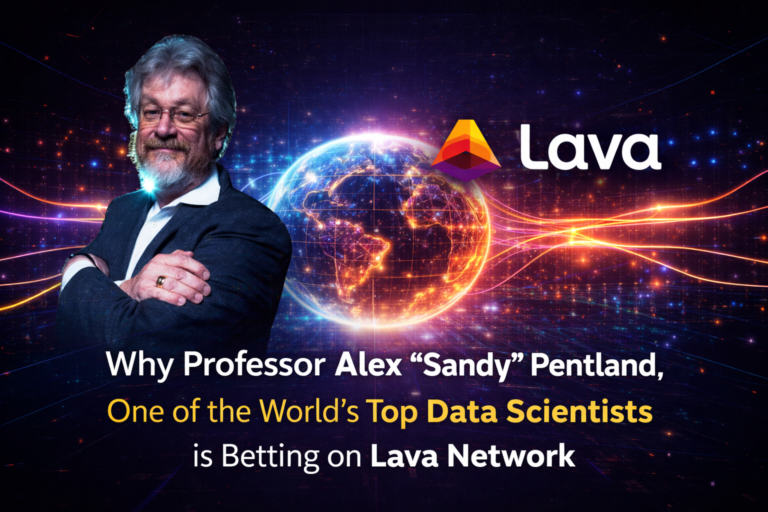
In the fast-moving world of small-cap infrastructure, names matter. But few names carry as much weight in the “physics of data” as Professor Alex “Sandy” Pentland.
When a man who helped architect GDPR and was named by Forbes as one of the “seven most powerful data scientists in the world” chooses a partner, he isn’t looking for a short-term marketing pump. He’s looking for the future of the internet’s “plumbing.”
As of early 2026, Professor Pentland has officially teamed up with Lava Network to research global standards for secure, trustworthy AI data. Here is why an academic giant of his caliber is betting on this specific protocol.
1. Solving the “Loyalty” Crisis in AI
Pentland’s recent work focuses on “Loyal AI Agents”—autonomous bots that have a legal and ethical duty to serve the user, not the corporation that built them.
The Bet: For an AI to be “loyal,” it needs data it can trust. If an AI fetches on-chain data through a centralized, opaque provider, that provider can manipulate the information.
The Lava Solution: Pentland is betting on Lava because its Smart Router and decentralized node marketplace provide a “verifiable paper trail” for every piece of data an AI touches.
2. Replacing a Broken Internet
Pentland has long argued that the current internet was built without built-in reputation or “provenance” (the ability to track where data started).
The Bet: As AI agents begin to handle our finances and medical data, “good enough” data isn’t enough.
The Lava Solution: By routing requests across independent, performance-tracked providers, Lava creates a resilient network where data integrity is the primary product. To Pentland, Lava is the experimental “living laboratory” where the new rules of the internet are being written.
3. Institutional Scalability
Pentland doesn’t just work in labs; he advises the UN, the World Economic Forum, and Google. He understands that for blockchain tech to go mainstream, it must be “enterprise-grade.”
The Bet: Lava’s recent integrations with Kraken and Fireblocks proved it can handle institutional volume. Pentland is likely betting that Lava’s modular “Specs” system is the only one flexible enough to become a global standard.
⚠️ The Investor’s Note: Sentiment vs. Structure
While Pentland’s “bet” is a massive long-term validation, investors should remain grounded:
Research ≠ Revenue (Yet): This is a research and standards initiative. It aligns Lava with the high-level AI + Blockchain narrative, but it won’t change the token’s circulating supply or mainnet utility tomorrow.
Volatility Outlook: News involving MIT and Pentland often triggers “speculative buzz.” Any resulting price action is likely sentiment-driven and could be short-lived.
The “Moat”: The real value here is the marketing moat. Having a “reputable academic figure” attached to the project makes it much harder for competitors to dismiss Lava as just another altcoin.
The Bottom Line: A Massive Technical Endorsement
Beyond the headlines, this collaboration represents a major show of trust in Lava Network’s underlying technology.
Professor Pentland has spent decades designing the “Internet of Trusted Data,” and his decision to research alongside Lava is a signal that their decentralized routing protocol isn’t just a “crypto tool”—it is a legitimate solution to the AI data crisis. For a small-cap project, having an architect of global privacy laws (GDPR) validate your infrastructure is the ultimate “Institutional Alpha.”
While the market often looks for “token burns” or “airdrops,” the most sustainable value comes from utility. By positioning itself as the secure, verifiable data layer for AI agents, Lava is moving from a speculative “infra play” to a much-needed utility for the next generation of the web. This isn’t just research; it’s a blueprint for how the world’s data will be routed in the AI era.